
The 30-share Sensex ended in the red.
Broking firm Jefferies says Indian financial system is now flooded with the kind of liquidity witnessed in 2005-07 and 2009-10

In the Sensex pack, index heavyweight Reliance Industries fell 2.84 per cent to Rs 1,057.15 after reports that the company's oil assets may take a hit due to the government's imposition of cost controls on soaring petrol and diesel prices.

Over the past several months, the airline has struggled to pay vendors and staff salaries on time.

At 12:25 PM, the barometer index, the S&P BSE Sensex was down 358 points or 1.3% at 26,368.

Given the uncertain macroeconomic conditions, most brokerages have turned slightly cautious on the pace of growth in State Bank of India's (SBI's) earnings going ahead. While they don't see any significant risk arising for now, its sheer balance sheet size and systematic importance has nudged them to cut earnings estimates for fiscal year 2023-24 (FY24) and 2024-25 (FY25) up to 5 per cent. India's largest state-owned bank, on Thursday, reported standalone net profit of Rs 16,694.51 crore for Q4FY23.

Shares of most of the Adani group firms ended lower on Monday, with the group companies' combined mcap witnessing a sharp fall of Rs 9.5 lakh crore after US-based short-seller Hindenburg Research's adverse report.

Sensex in green in afternoon trade.
Profit-booking and selling pressure on below-normal monsoon forecast, marred sentiments, traders said.

The combined market capitalisation of the 21 listed PSU banks declined by about Rs 76,000 crore to Rs 425,800 crore during the month.

Notable losers were ONGC, Axis Bank, ITC, SBI, ICICI Bank, NTPC, Hero Motocorp, Sun Pharma and Bharti Airtel who fell by up to 2.80 per cent.

Investors booked profits in recent gainers

At an aggregate level, the late ace investor's portfolio that was valued at Rs 32,445 crore as on March 31, 2023 is now worth Rs 35,979 crore.

'Markets could face uncertainty in the short to medium term.' 'It would be prudent to invest in alternative asset classes, especially debt, for about a year.' 'Bank fixed deposits are offering rates as high as 9 per cent per annum and these can be used as a great hedging tool until equity markets stabilise.'

The country's per capita income is likely to grow by close to 70 per cent to $4,000 by fiscal 2030 from $2,450 in fiscal 2023, helping it become a middle-income economy with $6-trillion GDP, more than half of which will be coming in from household consumption, says a research report. Per capita income/GDP has risen from $460 in fiscal 2001 to $1,413 in fiscal 2011 and further to $2,150 in fiscal 2021. The biggest growth driver will be external trade which may nearly double to $2.1 trillion by 2030 from $1.2 trillion in fiscal 2023 when the GDP printed in at $3.5 trillion, Standard Chartered Bank said in a weekend report which assumes a 10 per cent nominal GDP growth annually from now on.

Sensex climbs higher on favourable global cues.

Its total income (consolidated) rose to Rs 79,302.72 crore in the quarter under review, compared to Rs 74,948.51 crore in the year-ago period

Tata Steel, SBI, L&T and Sun Pharma advanced 2-5% each.

Prithvi Shaw said every run would be very important for him in his endeavour to make a comeback to the Indian team.

Equity benchmark index Sensex buckled under selling pressure for the second straight session to close below the 65k mark on Friday, as investors offloaded IT, teck and metal stocks amid a bearish global trend. Besides, fresh foreign fund outflows also hit investor sentiments, traders said. In a volatile trade, the 30-share BSE Sensex declined 202.36 points or 0.31 per cent to settle at 64,948.66.

On the Sensex chart, ONGC, Sun Pharma, NTPC, Bajaj Auto and HDFC were the top losers.

Loans, cash credits, and overdrafts at the end of December 22, 2017, stood at Rs 81,287.32 billion, against Rs 73,340 billion in the year-ago period.

Group term insurance is far more cost-effective than an individual cover.

This weakness is likely to continue in the near-term.

Benchmark stock indices Sensex and Nifty rebounded to close over 1 per cent higher on Thursday, propelled by buying in index majors Reliance Industries, HUL and Infosys along with an overall positive trend in global markets. The 30-share BSE benchmark jumped 701.67 points or 1.23 per cent to end at 57,521.06. During the day, it zoomed 971.46 points or 1.70 per cent to 57,790.85 on the expiry of derivatives contracts. The NSE Nifty rallied 206.65 points or 1.21 per cent to 17,245.05.
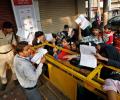
There is not much bank employees can do, but some words of encouragement from the management would have helped. Stretched working hours and the tense atmosphere is taking a toll on their health.

Markets end almost flat, bluechips in focus.

Gold slips by Rs 150 on low demand.

For far too long, individuals have been at the receiving end of unfair practices from various entities in the financial services industry. Now it's time to stand up and be counted!

The Popular Front of India (PFI), banned recently by the government for alleged terrorist links and spreading communal hatred, has a "well-structured and organised" presence in the Gulf countries for raising and mobilising funds, the Enforcement Directorate said on Monday after a local court took cognisance of its latest charge sheet filed against three PFI office-bearers.

Bajaj Finance was the top loser in the Sensex pack, shedding around 3 per cent, followed by UltraTech Cement, NTPC, Axis Bank, ICICI Bank, IndusInd Bank, Reliance Industries, L&T and HDFC Bank. NSE Nifty slipped 38.95 points to 14,834.85.

Earnings growth, attractive valuations and change in FPI flows from negative to positive over the next 12 months are some of the key triggers for an upside. "A poor monsoon, high inflation and further rate hike are some of the key risks
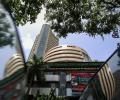
Shares of L&T Technology Services, an arm of engineering giant Larsen and Toubro, made a decent debut on the bourses
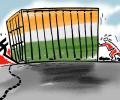
India has been relatively insulated from the severe headwinds in the West. However, with a third of the global economy expected to slip into recession in calendar year 2023, the impact will strongly be felt on India's exports and trade economy, leading economists said in a panel discussion at the Business Standard BFSI Insight Summit in Mumbai on Wednesday. The panel comprised former Reserve Bank of India executive director and former Monetary Policy Committee member Mridul Saggar, State Bank of India Chief Economic Advisor Soumya Kanti Ghosh, Citibank India Chief Economist Samiran Chakraborty, ICRA Chief Economist Aditi Nayar, and IndusInd Bank Chief Economist Gaurav Kapoor. The topic of the panel discussion was No recession in sight: Is India decoupled from developed economies?

Sensex closed over 118 points down on Thursday.

The World Bank group has been publishing annually 'Doing Business Report' since 2004.

Amid the ongoing festival season and ahead of the elections for five state assemblies, the Centre is closely monitoring inflation, particularly in food items, to enable it to take steps to increase their supplies. "There is a complete no-nonsense attitude when it comes to food inflation, and instructions have been issued at all levels to be very sensitive to any possible price movements in any commodity," a senior official explained. Sources have said that all departments dealing with food items have been instructed to keep a close eye on all commodities and maintain a weekly record of their price movements.

Sreejita De has named her brand #sreejitadeSupremacy.

He said the Finance Minister assured the delegation that the Financial Services Secretary would look into the matter and the settlement process would be expedited.
